
Choosing the right words can turn a simple sentence into a scene readers remember. Aspiring writers and students often find their stories or essays fall flat when lacking the vivid details that bring scenes to life. Descriptive words—adjectives, adverbs, and sensory language—create mental images that make your writing memorable and engaging. By learning to select and use these words with intention, you unlock new levels of creativity for storytelling and academic work.
Table of Contents
- Defining Descriptive Words In Writing
- Types Of Descriptive Words And Techniques
- Benefits For Storytelling And Academic Writing
- How Descriptive Words Engage Readers
- Common Misuses And What To Avoid
Key Takeaways
| Point | Details |
|---|---|
| Importance of Descriptive Words | Descriptive words transform writing by creating vivid mental images, engaging readers’ senses and emotions. |
| Categories and Techniques | Understanding various descriptive elements, such as adjectives and sensory language, enhances a writer’s ability to evoke responses and maintain reader interest. |
| Impact on Writing Contexts | Descriptive language significantly enriches both storytelling and academic writing, making concepts more relatable and memorable. |
| Common Pitfalls to Avoid | Writers should avoid over-description, vague language, and inconsistent tones to maintain clarity and engagement in their writing. |
Defining Descriptive Words in Writing
Descriptive words are the foundation of compelling writing. They’re the specific adjectives, adverbs, and sensory-focused language choices that transform flat, generic sentences into vivid scenes readers can actually see, hear, and feel. When you use descriptive words effectively, you’re not just adding decoration to your writing. You’re creating a bridge between your imagination and your reader’s mind, painting mental images that stick long after they finish reading.
At their core, descriptive words serve one fundamental purpose: they paint pictures with language. Rather than telling readers “the character walked into a room,” descriptive language lets you show them exactly what they need to see. Maybe the character slumped through a doorway, or charged across a threshold, or tiptoed carefully inside. Each choice reveals something different about the situation, the character’s mood, and the scene itself. This is where sensory-rich language creates mental images that make your writing memorable and engaging.
Descriptive words come in many forms. Adjectives describe nouns directly (“the crimson sunset,” “the deafening silence”). Adverbs modify verbs and other words (“she spoke softly,” “he walked purposefully”). But descriptive writing goes deeper than just listing pretty words. It requires you to choose language that appeals to all five senses and reveals your intention as a writer. When you describe a location, you might focus on what your reader sees (colors, shapes, light), what they hear (sounds, silence, echoes), what they smell (fresh air, decay, cooking), what they taste (salt in the air, sweetness), and what they feel (temperature, texture, movement). This multisensory approach is what separates bland writing from the kind that truly immerses readers in your world.
The power of descriptive words becomes especially clear when you compare them side by side. Consider these two versions:
- “The old house sat on the hill. It was dark and quiet inside.”
- “The weathered Victorian mansion perched on the ridge like a brooding sentinel. Inside, shadows pooled in corners while dust motes danced through thin slivers of afternoon light, and the air hung heavy with the scent of forgotten rooms.”
Both convey that there’s an old house on a hill, but only the second one actually makes you feel present in that space. The descriptive version uses specific, sensory words to engage your imagination, while the first version simply states facts. This distinction matters enormously for storytelling and academic writing alike. Whether you’re crafting a short story or writing an essay that needs to captivate readers, descriptive words transform your writing from something your audience merely reads into something they experience.
One practical place to start building your descriptive vocabulary is by exploring detailed word lists for descriptive adjectives that can enhance your writing toolkit. Many writers find that having access to organized collections of powerful descriptive words helps them move beyond repetitive choices and discover more precise, evocative language for their specific situations.
Pro tip: Create a personal word bank by collecting descriptive words you encounter in books, articles, and stories you admire. Review it before writing sessions to refresh your memory and push yourself beyond overused descriptions.
Types of Descriptive Words and Techniques
Descriptive writing isn’t one-size-fits-all. Different situations call for different types of descriptive words, and understanding these categories helps you choose the right language for your specific purpose. The main categories include adjectives, adverbs, vivid verbs, and sensory language. Adjectives modify nouns and form the backbone of most descriptive writing (“the silky fabric,” “the ancient door”). Adverbs modify verbs and other words, adding precision to action (“she spoke hesitantly,” “the rain fell steadily”). But powerful descriptive writing goes beyond these basics. Strong action verbs themselves can be descriptive. Instead of “the dog ran quickly,” you might write “the dog bolted” or “the dog sprinted.” Each choice carries a different emotional weight and creates a distinct mental image.
To create truly immersive writing, you need to understand how figurative language techniques like similes and metaphors work together with sensory details. Similes compare two things using “like” or “as” (“her voice was like honey”). Metaphors make direct comparisons without those connector words (“her voice was honey”). Personification gives human qualities to non-human things (“the wind whispered through the trees”). These literary devices transform ordinary descriptions into memorable images that stick with readers long after they finish. Combined with specific sensory language, they create the emotional depth that separates good writing from exceptional writing.
Sensory language is where descriptive writing truly comes alive. This involves deliberately engaging all five senses, not just what the reader sees. Consider a scene at a coffee shop. Visual descriptors focus on what you see (“steam rose from the ceramic cup”). Auditory language captures sound (“the espresso machine hissed and chirped”). Olfactory details appeal to smell (“the rich aroma of dark roast filled the air”). Tactile descriptions use touch (“the cup warmed her palms”). Gustatory language invokes taste (“bitter coffee lingered on her tongue”). When you layer these sensory elements together, you don’t just tell readers about a coffee shop. You transport them there.

Mood and atmosphere represent another crucial layer of descriptive technique. The words you choose create emotional tone and set the overall feeling of your piece. Dark, heavy words create a somber or ominous mood. Light, flowing words create a cheerful or peaceful feeling. For example, a house described as “cozy and welcoming” feels completely different from the same house described as “cramped and suffocating.” The physical space hasn’t changed, but your word choices have transformed the reader’s emotional response to it.
Here’s how these categories work together in practice:
- Adjectives describe qualities and characteristics directly
- Adverbs add nuance to how actions unfold
- Strong verbs carry emotional weight and eliminate the need for multiple modifiers
- Sensory language engages the reader’s physical senses
- Figurative language creates unexpected connections and deeper meaning
- Mood words establish the overall emotional tone
Building a rich vocabulary across all these categories helps you avoid repetition and keep your writing fresh. Rather than repeatedly using “beautiful” or “nice,” you can access dozens of alternatives depending on your specific context. A sunset might be “radiant,” “luminous,” “breathtaking,” or “resplendent,” each creating a slightly different impression. This variety isn’t just stylistic flourish. It’s the difference between writing that feels alive and writing that feels flat and recycled.
Pro tip: Practice describing the same object or scene using different categories of descriptive words. Write one version using primarily adjectives, another using sensory language, and a third using figurative language. Notice how each approach creates a different feeling, then blend techniques to achieve exactly the mood and effect you want.
Here is a comparison of descriptive word types and how they enhance writing:
| Descriptive Type | Primary Role | Example Usage | Impact on Writing |
|---|---|---|---|
| Adjectives | Describe qualities of nouns | The cozy cottage | Adds visual detail |
| Adverbs | Modify verbs/adjectives | Spoke softly, ran quickly | Refines action and intensity |
| Vivid Verbs | Express action with clarity | Sprint, slither, explode | Increases energy and tone |
| Sensory Language | Engage the five senses | Crisp leaves, bitter coffee | Immerses readers in scenes |
| Figurative Language | Create imaginative links | Her smile was sunshine | Evokes emotion and meaning |
Benefits for Storytelling and Academic Writing
Descriptive words serve vastly different purposes depending on whether you’re crafting a short story or writing an academic essay, yet the core benefit remains the same: they transform ordinary writing into something readers actually want to engage with. For storytellers, descriptive language is the oxygen that keeps narratives alive. Without it, you’re left with a skeleton of plot points and dialogue. With it, you create entire worlds that readers can inhabit. When a reader experiences vivid sensory experiences through descriptive writing, they stop passively consuming your words and start actively living inside your story. That’s the moment a good story becomes unforgettable.
In creative storytelling specifically, descriptive words accomplish several critical functions. They establish setting so readers know exactly where they are. They reveal character through small behavioral details rather than explicit explanation. They create pacing and rhythm that control how quickly readers move through scenes. A tense moment might use short, punchy descriptive words to quicken the pace. A reflective moment might use longer, flowing descriptions that allow readers to linger. The emotional arc of your entire story rides on these subtle descriptive choices. Consider how different two versions of the same scene feel: “She walked into the room and saw him sitting there” versus “She pushed through the heavy door, her breath catching as she spotted him slumped in the corner chair, fingers trembling around a cold coffee cup.” Both convey the basic information, but only the second creates an emotional experience.
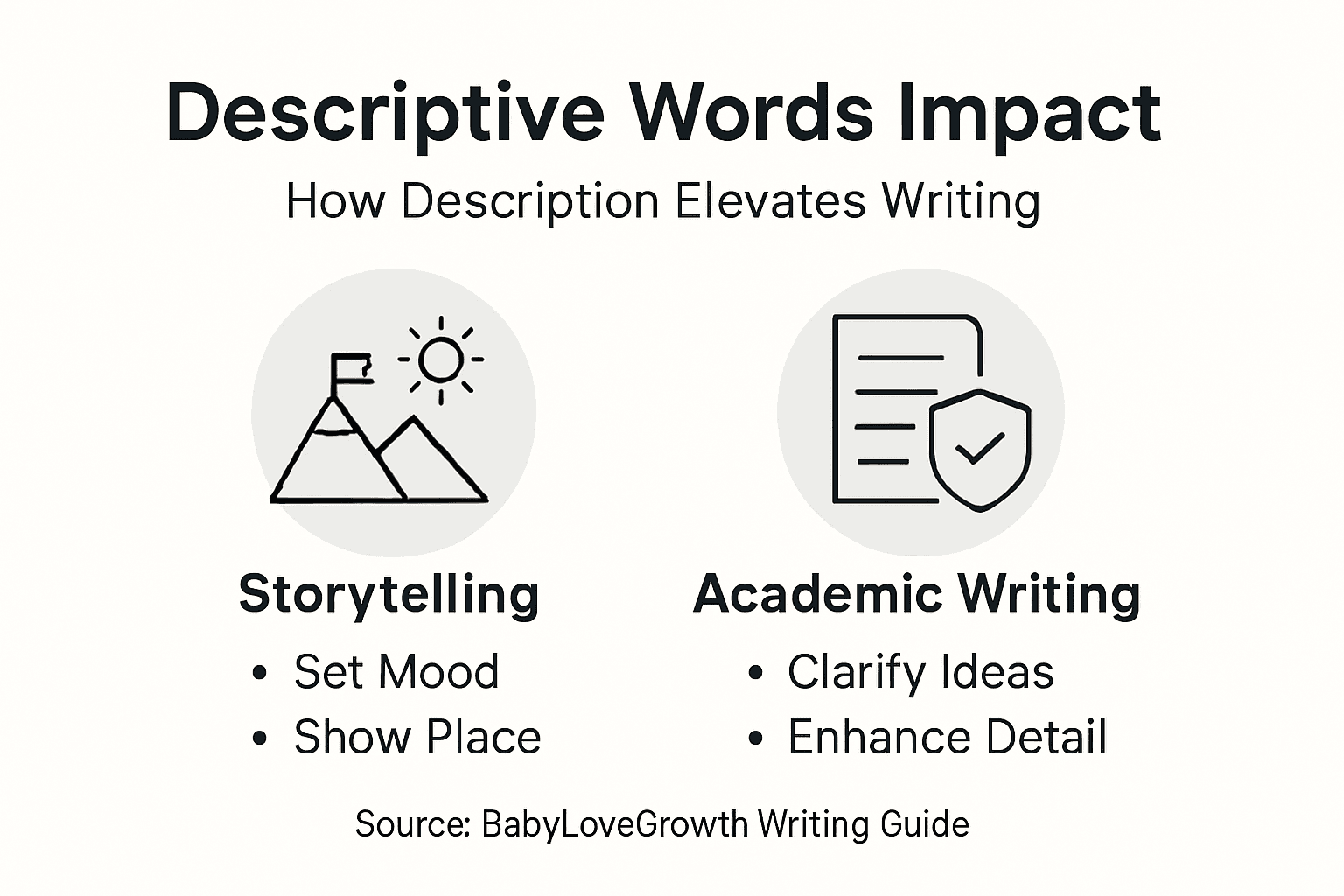
For academic writing, the benefits of descriptive language might seem less obvious, but they’re equally powerful. Descriptive words help clarify complex concepts by anchoring abstract ideas in concrete details. They make dense information more accessible by creating mental images that aid comprehension. When you’re explaining a difficult historical event, a scientific process, or a philosophical concept, strategic descriptive language acts as a bridge between what you’re describing and what your reader can actually visualize and understand. Additionally, descriptive writing strengthens your credibility by demonstrating that you deeply understand your subject matter. A researcher who can describe findings with precision and specificity commands more authority than one using generic language. Your choice of descriptive words signals whether you’re a surface-level observer or someone genuinely immersed in the material.
The emotional engagement factor matters in both contexts, though it manifests differently. In storytelling, descriptive words create the emotional stakes that make readers care about outcomes. In academic writing, they create investment in ideas. When a literature review is written with vivid descriptions of research findings rather than flat summaries, readers stay engaged. When a policy analysis uses descriptive language to paint pictures of real-world impacts, the abstract becomes tangible and urgent. Eliciting emotional responses through descriptive writing isn’t manipulative or inappropriate in academic contexts. It’s simply the most effective way to communicate that your ideas matter.
Here’s what descriptive words accomplish across both contexts:
- Increased reader engagement through sensory immersion and emotional connection
- Improved comprehension by making abstract concepts concrete and memorable
- Stronger voice that distinguishes your writing from generic alternatives
- Better retention because readers remember vivid descriptions far longer than plain statements
- Enhanced credibility through precision and depth of knowledge
- More effective communication of your core message or narrative
The key difference lies in application. Storytellers prioritize sensory detail and emotional resonance. Academic writers balance descriptive richness with clarity and evidence. But both benefit from moving beyond the bare minimum and investing in language that truly communicates your message. Your audience will spend time with your words. They deserve to experience writing that’s been carefully crafted with attention to descriptive precision.
Pro tip: Read your writing aloud and listen for places where it feels flat or generic. Identify weak descriptive language, then replace it with more specific, sensory-rich alternatives. Often, just three or four strategic word changes can transform a paragraph from forgettable to memorable.
This table contrasts the effects of descriptive language in storytelling versus academic writing:
| Writing Context | Core Purpose | Reader Effect | Key Benefit |
|---|---|---|---|
| Storytelling | Build vivid worlds | Emotional immersion | Strong narrative presence |
| Academic Writing | Clarify complex ideas | Improved retention | Enhanced comprehension |
| Both | Engage and inform | Lasting memory | Clear, memorable content |
How Descriptive Words Engage Readers
Reader engagement isn’t something that happens accidentally. It’s the direct result of intentional choices you make about language, and descriptive words are your most powerful tool for creating that connection. When you use generic language, readers scan. When you use descriptive language, readers pause and actually experience what you’re describing. The difference is measurable and immediate. Think about how you feel reading a dry list of facts versus reading a story that pulls you in. That difference comes almost entirely from descriptive word choices.
The mechanism of engagement works through sensory immersion. When readers encounter vivid sensory details that help them visualize scenes, something shifts neurologically. Their brains activate the same regions as if they were actually experiencing what you’re describing. A reader encountering “the wind blew” experiences minimal engagement. But a reader encountering “the wind clawed at her jacket, stealing her breath” activates sensory pathways, emotional centers, and memory associations simultaneously. You’ve transported them from passive consumption to active participation. This neurological engagement is what transforms casual readers into absorbed ones who can’t put your work down.
Descriptive words accomplish this engagement by creating multiple points of connection with your audience. Visual descriptions let readers see your world. Auditory language lets them hear it. Tactile details let them feel textures and temperatures. When you layer these sensory elements together, you’re not just providing information. You’re creating an experiential pathway that mirrors how humans naturally understand the world. Readers don’t just learn what happened. They understand what it felt like, what it sounded like, what it smelled like. This multisensory engagement dramatically increases both comprehension and retention. Studies consistently show that people remember information significantly longer when it’s paired with sensory and emotional content than when it’s presented as plain facts.
Emotional engagement amplifies sensory engagement even further. Consider how the same setting feels completely different depending on your descriptive word choices. “The house stood on the hill” is neutral. “The house loomed on the hill” creates unease. “The house perched on the hill” creates a sense of delicate precariousness. “The house sprawled across the hill” creates an impression of abundance and dominance. Same location. Completely different emotional responses. This is how descriptive words control reader emotion without being heavy-handed or manipulative. You’re simply choosing precise language that accurately captures your intended meaning, and that precision automatically triggers appropriate emotional responses.
The practical reality is that descriptive writing invites readers into the writer’s world by painting specific sensory pictures. Readers don’t want to work hard to understand what you mean. They want you to show them. When you make that effort through careful descriptive choices, readers reward you with their attention, their time, and their emotional investment. Here’s what that looks like in practice:
- Attention span extension: Descriptive language keeps readers engaged longer because they’re actively processing sensory information
- Emotional resonance: Specific descriptions trigger feelings and associations that generic language never touches
- Authority building: Precise descriptive language signals that you genuinely understand your subject
- Memorability: Vivid descriptions create mental images that linger in readers’ minds for years
- Connection: Sensory details create common ground between writer and reader
The counterintuitive truth is that adding more descriptive language often makes your writing shorter and more powerful, not longer and more bloated. This happens because precise descriptive words replace vague explanations. Instead of writing “The presentation was confusing and the audience didn’t understand it,” you might write “The speaker stumbled through incomprehensible charts while the audience exchanged bewildered glances.” The second version is more concise and infinitely more engaging. You’ve shown instead of told, and in doing so, you’ve actually cut words while dramatically increasing impact.
Pro tip: Notice when your own attention drifts while reading something. Identify whether the text is using generic language or lacks sensory detail. Then apply that insight to your own writing. Ask yourself whether your reader would drift at this point, and if so, strengthen your descriptive language before they have the chance to disengage.
Common Misuses and What to Avoid
Descriptive writing has a dark side that catches many writers off guard. The same tool that elevates writing can absolutely destroy it when misused. The trap is deceptively simple: if descriptive words are good, then more descriptive words must be better. This logic sounds reasonable until you end up with prose so cluttered that readers can’t find the actual story underneath all the adjectives. Learning what to avoid is just as important as learning what to embrace, because one misplaced purple prose section can undermine an entire piece of writing.
The most common mistake is over-describing through adjective stacking. This happens when writers pile multiple adjectives together, creating a list rather than a picture. Consider this example: “The tall, dark, handsome, mysterious, brooding man walked into the beautiful, elegant, spacious, ornate room.” Each individual word might be appropriate, but together they create a catalog instead of an image. Your reader’s brain can’t process that many descriptive layers simultaneously. They stop engaging and start skimming. The solution isn’t to eliminate adjectives but to choose fewer, more strategic ones. “The brooding man entered the marble hall” does far more work than the bloated version. One strong adjective per noun is often sufficient. The rest of your description can come from action, dialogue, and sensory details rather than from stacking descriptors.
Another critical pitfall is using vague, overused descriptors that have lost their impact through repetition. Words like “beautiful,” “amazing,” “wonderful,” and “nice” appear so frequently in writing that they’ve become invisible to readers. When you write “She had beautiful eyes,” your reader doesn’t create a mental image. They skip over the word entirely because it carries no information. Beautiful eyes compared to what? What makes these eyes specific and memorable? Instead, describe the actual quality: “Her eyes were the color of storm clouds” or “Her eyes held the brightness of winter sunlight.” These concrete descriptions give readers something actual to visualize. Overusing vague or overused descriptors weakens writing and makes your work feel generic and unmemorable. The effort to find more precise language pays dividends in reader engagement.
Precision matters more than volume. Many new writers believe that showing their work means describing every single detail of a scene. They describe the room’s dimensions, the furniture arrangement, the wall color, the lighting quality, the number of windows, and on and on. This isn’t showing. This is information dumping dressed up as description. Readers don’t remember catalogs. They remember the details that matter emotionally or narratively. If a room’s clutter signals a character’s mental state, describe the specific mess. If a room’s sterility reflects coldness, capture that feeling through selective detail. Trust your reader’s imagination to fill in gaps. A master bedroom needs only one or two specific details to become real in a reader’s mind.
Here are the primary pitfalls to recognize and avoid:
- Adjective stacking: Multiple adjectives before a noun create lists, not images
- Generic descriptors: Words like “nice” and “pretty” carry no specific meaning
- Over-describing: Including every detail rather than selecting strategic ones
- Telling instead of showing: Using adjectives to state emotions instead of creating situations that demonstrate them
- Inconsistent tone: Shifting from realistic to flowery language within the same piece
- Forced metaphors: Using figurative language that doesn’t fit your voice or context
- Purple prose: Ornate language that draws attention to itself rather than to your content
The balance you’re seeking is what separates professional writing from amateur writing. Professional writers know when to use descriptive language and when to get out of the way. They understand that the most powerful description often requires constraint rather than abundance. A single perfectly chosen word beats a paragraph of approximations. Context matters too. A horror story allows more theatrical description than a police report. A love poem can sustain more sensory detail than a technical manual. Understanding your genre, audience, and purpose helps you calibrate how much descriptive language serves your actual goals rather than your ego.
Pro tip: After you finish writing a section, read it aloud and circle every adjective. If you have more than two adjectives in any sentence, consider whether each one earns its place or if one stronger word could replace them all. This single editing pass eliminates most over-description problems.
Enhance Your Writing with the Power of Descriptive Words
Struggling to find the perfect words that bring your stories and essays to life Descriptive words are key to transforming ordinary text into vivid experiences that captivate your readers. The challenge is moving beyond tired, generic adjectives to language that truly engages the senses and emotions. This article highlights practical techniques like sensory language and figurative devices that elevate writing impact but finding the right words is often the hardest part. That’s where Curatwords.com comes in.

Explore our curated collections of descriptive adjectives and thematic word lists tailored to inspire writers, students, and educators seeking rich vocabulary choices. Whether you want to replace bland descriptions or find the exact word that perfectly fits your scene or concept visit Curatwords.com today. Unlock powerful language tools that will transform your writing from forgettable to unforgettable now.
Frequently Asked Questions
What are descriptive words in writing?
Descriptive words are specific adjectives, adverbs, and sensory-focused language that enhance writing by painting vivid mental images for readers. They help transform ordinary sentences into engaging and memorable experiences.
How can I improve my descriptive writing?
You can improve your descriptive writing by using sensory language that appeals to sight, sound, smell, taste, and touch. Additionally, exploring detailed word lists and maintaining a personal word bank can help you find precise and evocative language.
What types of descriptive words should I use?
Focus on using adjectives, adverbs, vivid verbs, and sensory language. Each type serves a distinct role, such as describing qualities, modifying actions, or engaging the senses to create an immersive experience for your reader.
How do descriptive words impact reader engagement?
Descriptive words enhance reader engagement by creating sensory immersion and emotional resonance. When readers encounter vivid descriptions, they are more likely to connect emotionally with the writing and visualize the scenes presented.